




High-Quality Golden Pompano Fingerling Supply Services – Van Tin Golden
Premium biological-standard Golden Pompano (Trachinotus blochii) fingerling supply solution by Van Tin Golden. Closed-loop nursing protocols, stringent biosecurity controls, exceptional survival rates, and optimized economic yields for marine cage farming.
Index
1. Foundations: Market Demand & Fingerling Supply Capacity
Corporate Credentials & Supply Infrastructure
2. Values & Technical Specifications Across Fingerling Grading
Fingerling Size Grading & Target Survival Rates
Quality Assessment Standards for Dispatched Seed
3. Breakthroughs: Bio-Standard Nursing & Zero-Shock Stocking
Van Tin Golden 4-Step Quality Control Protocol
Zero-Shock Stocking Protocol for Sea Cages
4. Market Reach: Water Quality Standards & Distribution Network
Water Quality Thresholds for Golden Pompano Cage Culture
5. Objectives & Precision Nutrition Strategies for Peak Growth
Feeding Management Across Growth Stages
6. Operations: Disease Biosecurity & Technical Support Commitments
1. Foundations: Market Demand & Fingerling Supply Capacity
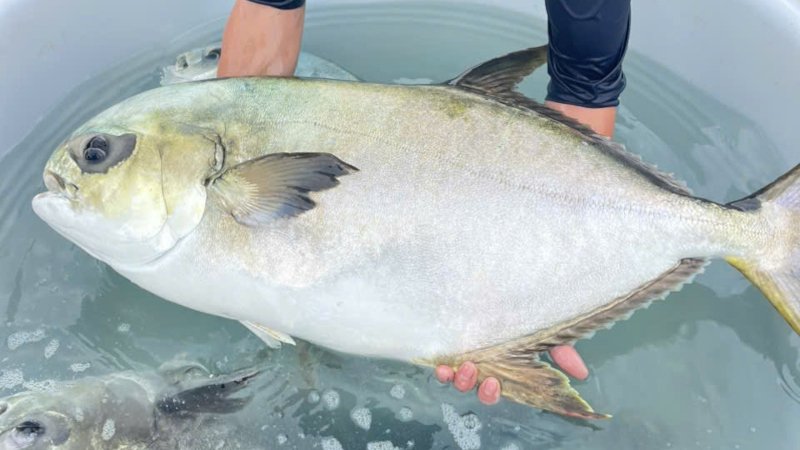
The Golden Pompano (Trachinotus blochii) represents one of the highest commercial-value marine aquaculture species in Vietnam today. With key attributes such as rapid growth velocity, high nutritional value, excellent environmental adaptability, and strong market demand, Golden Pompano has become a premier choice for marine cage farmers and large-scale enterprise investors alike.
However, field production realities show that fingerling quality governs over 60% of the entire grow-out cycle's success. Selecting uncertified, poor-quality seed, or stocking fingerlings compromised by stress and pathogen loads during transit frequently leads to severe mortality, inflated Feed Conversion Ratios (FCR), and extended harvest timelines.
Addressing these core challenges, VAN TIN GOLDEN CO., LTD.—operating 4 modern nursing and production facilities spanning 15 hectares of water surface in Van Ninh, Khanh Hoa Province—delivers industrial-scale fingerling supply services nationwide. Producing up to 15,000,000 Golden Pompano fingerlings annually, Van Tin Golden guarantees robust, uniform, disease-free seed with superior stress resistance.
Corporate Credentials & Supply Infrastructure
- Operating Enterprise: VAN TIN GOLDEN CO., LTD
- Tax Code (MST): 4202050071
- Main Headquarters: 32B To Hien Thanh, Van Ninh Commune, Khanh Hoa Province, Vietnam
- Infrastructure Scale: 4 standardized nursing facilities across 15 hectares of sea surface
- Annual Pompano Fingerling Capacity: 15,000,000 pcs/year
- Technical Hotline & Sales: (+84) 0966 229 962
- Official Channels: vantingolden.com | facebook.com/cagiong.vantin
2. Values & Technical Specifications Across Fingerling Grading
Fingerling Size Grading & Target Survival Rates
| Seed Grade Class | Body Length (cm) | Average Weight (g) | Target Survival Rate (%) | Grow-out Duration | Economic Advantages |
|---|---|---|---|---|---|
| Standard Grade 1 | 3 - 5 cm | 3 - 5 g/pc | 75% - 85% | 8 - 9 months | Low initial seed investment, optimized long-distance transport density |
| Medium Grade 2 | 5 - 8 cm | 8 - 15 g/pc | 85% - 92% | 7 - 8 months | Strong immunity, rapid environmental acclimatization |
| Large Grade 3 (Juvenile) | 8 - 12 cm | 20 - 35 g/pc | 95% - 98% | 5 - 6 months | Shortened crop cycle, minimized seasonal storm risks |
Quality Assessment Standards for Dispatched Seed
- Morphological Integrity: Bright, intact scales; vibrant yellow coloration on caudal and pelvic fins characteristic of purebred Trachinotus blochii; body free from abrasions or fin erosion.
- Behavioral Vigor: Strong schooling instinct, rapid reaction to auditory and light stimuli, swift diving response upon environmental disturbance.
- Biosecurity Verification: 100% of batches undergo random PCR testing prior to release, certifying zero detection of key pathogens including Vibrio spp., Nodavirus, and ectoparasites.
3. Breakthroughs: Bio-Standard Nursing & Zero-Shock Stocking
Van Tin Golden 4-Step Quality Control Protocol
- Broodstock Genetic Screening: Rigorous selection of non-inbred, healthy broodstock lines exhibiting rapid growth traits and robust natural disease resistance.
- Recirculating Bio-Nursing: Specialized nursery tanks equipped with biological filtration, holding water parameters at optimal levels (Salinity 25–32‰, pH 7.5–8.5, DO > 5 mg/L).
- Precision Bio-Nutrition: Fry are raised on DHA/EPA-enriched live feeds (Rotifers, Artemia) paired with scheduled fortification of Vitamin C, B-Complex, and gut probiotics.
- Current Conditioning & Feed Training: 7 days prior to dispatch, fingerlings are conditioned against water currents and trained on floating pellet feeds for seamless cage integration.
Zero-Shock Stocking Protocol for Sea Cages
- Environmental Verification: Measure and compare salinity, pH, and temperature between transport containers and receiving sea cage waters.
- Thermal Equilibrium: Submerge sealed transport bags directly in the cage water for 15–20 minutes to equalize internal and external temperatures.
- Salinity Acclimatization: Open bags and incrementally add cage water (20% volume per step) every 5–10 minutes to ease osmotic transition.
- Controlled Release: Allow fingerlings to swim out voluntarily during cooler hours (early morning 5:00–7:00 AM or late afternoon 4:00–6:00 PM).
4. Market Reach: Water Quality Standards & Distribution Network
To maximize fingerling performance post-stocking, sea cages should be positioned in sheltered bays with good tidal exchange and maintain standardized water parameters.
Water Quality Thresholds for Golden Pompano Cage Culture
| Environmental Parameter | Optimal Target Range | Warning Threshold | Actionable Technical Solution |
|---|---|---|---|
| Water Temperature | 26°C - 30°C | < 22°C or > 32°C | Lower cage net depth to cooler water layers |
| Sea Salinity | 25‰ - 32‰ | < 15‰ (heavy rains) | Reduce daily feed rations by 30 - 50% to prevent stress |
| Dissolved Oxygen (DO) | > 5.0 mg/L | < 3.0 mg/L | Deploy supplementary aeration or paddlewheel units |
| pH Level | 7.5 - 8.5 | < 7.0 or > 9.0 | Suspend agricultural lime bags around cage corners |
| Water Clarity (Secchi) | 1.5 - 2.5 m | < 0.5 m (turbid) | Halt net cleaning to avoid gill irritation from suspended sediment |
5. Objectives & Precision Nutrition Strategies for Peak Growth
Feeding Management Across Growth Stages
- Fingerling Stage (3 - 8 cm): High-protein floating pellets (42% - 45% crude protein) fed 4 times daily at 6% - 8% of total biomass.
- Juvenile Stage (8 - 20 cm): Transition to 38% - 40% protein diets fed 2 - 3 times daily at 3% - 5% of body weight.
- Grow-Out Stage (> 20 cm): 35% - 38% protein diets fed twice daily at fixed hours to maintain consistent feeding response.
- Health Fortification: Coat feed twice weekly with Vitamin C, B-Complex, Beta-glucan, and gut probiotics to reinforce immune defenses.